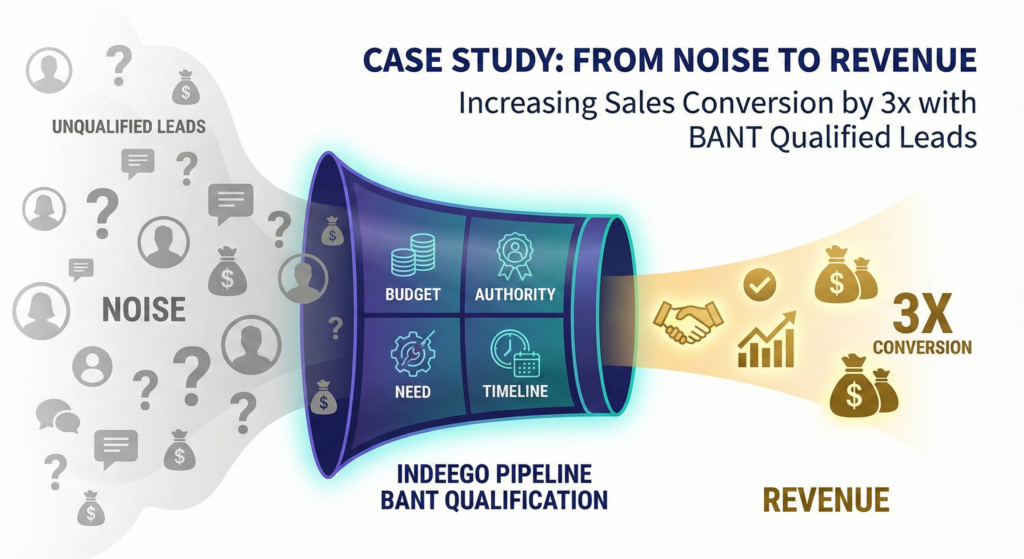
From Noise to Revenue: Increasing Sales Conversion by 3x with BANT Qualified Leads
Indeego Header About Us Our Data Driving smarter marketing decisions through accurate, actionable data insights. What We Make Possible Demand Helping brands attract the right audience at the perfect time. Engagement Connecting decision-makers with messages that resonate deeply. Insights Turning campaign data into actionable business intelligence. Digital Optimizing multi-channel reach through targeted strategies. Connection Building lasting relationships with qualified industry buyers. Experience Delivering exceptional brand interactions that inspire action. Careers Resources Blog Stay ahead with insights and trends. Case Studies Discover real success stories. Contact Us Menu × About Us Our Data What We Make Possible Demand Engagement Insights Digital Connection Experience Careers Resources Blog Case Studies Contact Us From Noise to Revenue: Increasing Sales Conversion by 3x with BANT Qualified Leads Case Study: The BANT Qualification Revolution That Tripled SaaS Revenue Case Study: The BANT Qualification Revolution That Tripled SaaS Revenue An in-depth 5,000-word analysis of how strategic BANT qualification transformed lead management for a SaaS company, reducing pipeline noise by 60% while increasing revenue 300% through precision targeting and qualification rigor. Client Profile: Client Alpha (Enterprise SaaS Platform) Industry: B2B SaaS – Workflow Automation Company Size: 85 employees Annual Revenue: $8 million (pre-intervention) Location: Austin, Texas Target Market: Mid-market to Enterprise ($10k+ ACV) Challenge: High lead volume with low conversion, sales team burnout, inconsistent pipeline quality In the modern SaaS landscape, marketing teams are often rewarded for quantity—more leads, more downloads, more signups. But what happens when this “lead factory” produces more noise than revenue? For Client Alpha, a promising enterprise workflow automation platform, this disconnect between marketing metrics and sales reality was creating organizational chaos and revenue stagnation. The “Pipeline Bloat” Epidemic: When Quantity Destroys Quality Client Alpha’s marketing engine was firing on all cylinders. Through sophisticated content marketing, SEO, webinars, and targeted advertising, they were generating 1,000-1,200 new leads monthly—an impressive number for an 85-person company. Marketing dashboards glowed green with success metrics, and lead generation reports celebrated exponential growth. Yet in the sales department, a different reality unfolded. Ten highly-compensated Account Executives, each receiving 100+ leads monthly, found themselves drowning in activity but starved for actual revenue. The disconnect wasn’t in effort or skill—it was in the fundamental nature of the leads themselves. The Anatomy of Failed Leads Our forensic analysis revealed that 70% of their “marketing qualified leads” (MQLs) fell into non-buyer categories: The Four Categories of Pipeline Noise: Academic Researchers (25%): Students, professors, and university teams using the platform for research projects with zero purchasing authority Freelancer Explorers (20%): Individual consultants and small agencies seeking free access to premium features for client projects Startup Dreamers (15%): Early-stage founders with ambitious plans but sub-$50k annual revenue and no budget allocation Competitive Intelligence (10%): Direct competitors analyzing features, pricing, and implementation processes with no purchase intent The Financial and Human Cost The consequences extended beyond missed quotas: 2% Lead-to-Meeting Rate $1.2M Annual Sales Salary Waste 42% Annual Rep Turnover 9 Months Average Sales Cycle “We built the most sophisticated marketing funnel in our category. We were generating leads at 1/3 the industry cost. Yet our sales team was the most demoralized I’ve ever seen. They were doing everything right—making calls, sending follow-ups, customizing demos—but they were fishing in a pond with no fish.” — CMO, Client Alpha Diagnosing the Root Cause: Why Standard Qualification Fails The conventional wisdom in SaaS marketing suggests that any engagement is good engagement. Download a whitepaper? MQL. Attend a webinar? MQL. Request a pricing page? MQL. This “MQL-first” approach creates a fundamental problem: it confuses interest with intent. The Interest vs. Intent Fallacy Interest is passive—someone reading about your industry, researching solutions, or exploring options. Intent is active—someone with budget, authority, need, and timeline to make a purchase decision. Client Alpha’s marketing automation scored for interest but couldn’t discern intent. The MQL-SQL Disconnect Marketing defined MQLs by behavioral triggers (downloads, page views, form fills). Sales needed SQLs (Sales Qualified Leads) defined by buying criteria. The handoff between these two definitions was broken, creating organizational friction and wasted effort. The BANT Framework Reinvented: From Checklist to Conversation Most companies treat BANT as a qualification form—four checkboxes on a lead capture page. This approach fails because buyers rarely disclose true budget, authority, need, or timeline in an initial form. At Indeego Pipeline, we reimagined BANT as a structured conversation framework rather than a data collection exercise. B Budget Financial capacity and allocation discovery A Authority Decision-making power and influence mapping N Need Pain point validation and business impact analysis T Timeline Implementation urgency and decision cadence Phase 1: The BANT Qualification Firewall We implemented what we called the “BANT Firewall”—a dedicated team of Indeego qualification specialists who sat between marketing automation and sales outreach. No lead reached an Account Executive without passing through this human verification layer. The Budget Conversation: Beyond “What’s Your Budget?” Traditional budget questions fail because buyers either don’t know their budget or won’t disclose it early. Our approach focused on financial conversation rather than direct inquiry: INDEEGO QUALIFICATION SCRIPT – BUDGET EXPLORATION: “I understand implementations like this typically range from $15,000 to $75,000 depending on scope and customization. Given what you’ve shared about your team size and requirements, would this be something you’d need to build a business case for in the next quarter, or do you already have budget allocated for workflow optimization this fiscal year?” Why this works: This approach establishes context, provides a realistic range, and asks about budget allocation rather than specific amounts. It separates prospects who need to build a business case (longer sales cycle) from those with immediate budget (shorter cycle). The Authority Mapping: Beyond Job Titles In enterprise B2B sales, buying decisions involve committees, not individuals. Our qualification specialists were trained to map organizational influence: INDEEGO QUALIFICATION SCRIPT – AUTHORITY MAPPING: “For a decision of this scale, who besides yourself typically needs to weigh in? Would that include your CFO for budget approval, your Head of Security for compliance, and perhaps your Head of Engineering for implementation feasibility? Should we